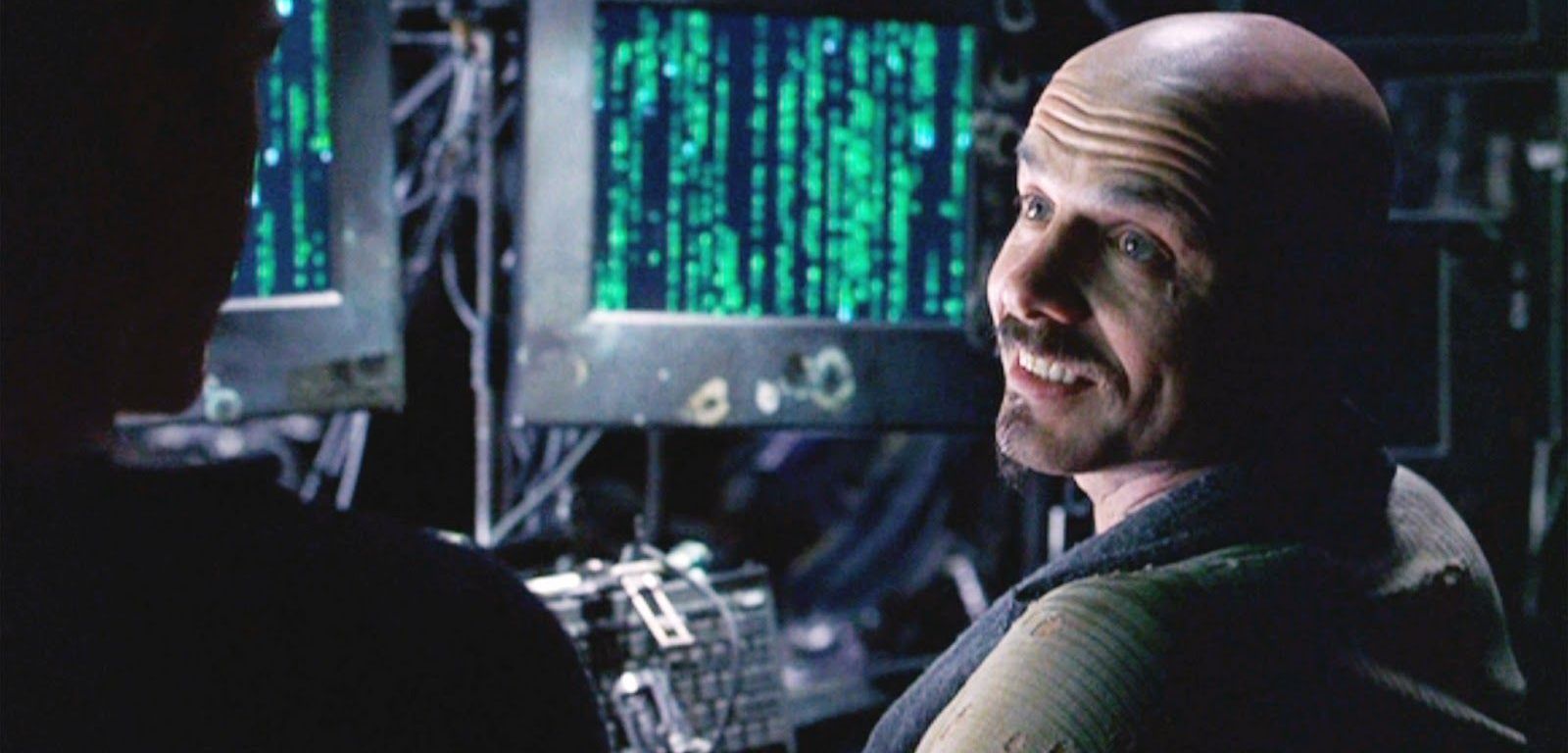
Cypher, The Matrix, circa 2199
Remember that line?
If you are old enough to have seen The Matrix when it first came out — or old enough to remember when the internet still felt like a place you visited instead of a weather system you lived inside — you probably do.
Neo is staring at a screen of falling green code, trying to understand how anyone could possibly read the Matrix that way. Cypher, already halfway gone into cynicism and steakhouse betrayal, explains that eventually you stop seeing the code. The symbols become the world. “I don’t even see the code,” he says. “All I see is blonde, brunette, and redhead.”
“I don’t even see
the code,”
That was the first image that came to mind when I saw the news many of us in tech had been expecting, though maybe not this soon: the web, as measured by Cloudflare, appears to have crossed into a bot-majority era.
Which sounds dramatic until you think about it for five seconds. My friend Eric Santos from AI Connect had this already thought out, he even mentioned that our clones should be also able to talk to agents and then he went on and built sxsw.md.
What did we expect would happen once search crawlers, AI scrapers, and autonomous agents all began moving across the web at machine speed? That the old human-facing internet — the one with nav bars, hero images, newsletter pop-ups, cookie banners, carefully A/B-tested buttons, and desperate little “Accept All” prompts — would remain the main event forever?
For 30 years, we built websites for humans who see. But the fastest-growing audience on the web does not see. It parses. It fetches. It summarizes. It extracts. Like Cypher, it does not need the interface. It reads the structure underneath.
The web is becoming legible to machines first.
Nicholas Thompson recently pointed to Cloudflare data and Matthew Prince’s warning that the line has been crossed earlier than expected: automated traffic is now larger than human traffic on the web as Cloudflare measures it. The careful phrase matters. This is not “the internet” in some mystical, totalizing sense. Cloudflare Radar’s bot-versus-human view tracks automated versus human HTTP requests to HTML content — web page traffic across Cloudflare’s network, not every Netflix stream, app session, game server, private API call, or encrypted corner of digital life.
Still, the symbolic threshold is hard to ignore.
This is not a rounding error. This is a phase change.
And phase changes are where things get interesting.
The mistake would be to treat this as an invasion story: the bots came, the humans lost, cue the ominous soundtrack. That is too easy, and probably wrong. Most bots are not tiny villains in black hoodies. Some are Googlebot and Bingbot doing the old work of indexing the web. Some are AI crawlers gathering pages to train or ground language models. Some are agents acting on behalf of humans, moving through websites to compare products, retrieve information, fill forms, book things, compile research, or complete tasks that used to require a browser, a coffee, and an afternoon of mild despair.
In other words: many of these bots are not replacing humans so much as they are in many cases now becoming our remote limbs.
The question is not whether bots belong on the web. They already live here. The question is whether the web’s architecture, economics, and etiquette can survive the fact that its primary reader may no longer be a person with eyes, patience, and a credit card.
The original website was a theater. Even the ugliest one had staging. A homepage had a hierarchy. A headline was meant to catch the human mind mid-scroll. A menu promised orientation. A hero image manufactured mood. A button whispered, or begged, “Click me.” The whole thing assumed a visitor with senses, preferences, hesitation, and boredom.
The bot does not care
about the theater.
It wants the script, the exits, the price of admission, the rights attached to the content, and the fastest path to the thing it was sent to retrieve. It does not need the marble lobby. It needs the service entrance.
That is why the website is about to split into two layers. One layer will remain human-facing: visual, branded, narrative, emotional, seductive. The other will be machine-facing: structured, attributable, permissioned, priced, and optimized for agents that do not browse so much as transact.
Some may describe this as a web “quietly bifurcating”: one human-facing layer where things are read and judged, and another layer of “transactional plumbing” where agents serve other agents. That sounds like science fiction only because we still picture websites as pages. Increasingly, they are becoming resources.
This is the return of a very old internet idea in a very new costume. RSS feeds were machine-readable versions of publishing. APIs gave software a door that humans did not need. Schema markup taught search engines how to understand recipes, products, reviews, events, and organizations. What changes now is the scale and the intelligence of the reader.
The machine-readable web used to be metadata around the edges. Now it may become the main road.
The website is no longer just a destination. It is becoming a source of record.
For a long time, the web’s default economic prayer was simple: bring people to the page.
People could see ads. People could subscribe. People could click affiliate links. People could be retargeted, upsold, paywalled, cookied, nurtured, converted, reactivated, and otherwise processed through the liturgy of digital marketing. A visit was never just a visit. It was an opportunity to monetize attention.
Bots break that model because they decouple information from visitation.
An AI answer can consume a page without sending a human to it. An agent can compare five products without looking at five product pages in the way a shopper would. A research assistant can summarize 20 articles while exposing the original publishers to little or no direct attention. The old bargain — create useful information, attract traffic, monetize the audience — starts to wobble when the audience is an intermediary.
This is already visible in the anxiety around AI search and answer engines. The competitor is no longer just another website ranking higher on Google. It is the answer box before the click. Or worse: the summary of the summary of the summary that arrives in a chat interface with no visible memory of where the value came from.
Karin Andrea Stephan framed it as the new playbook: become a trusted source, become crawlable and attributable, become the system of record for expertise, and monetize trust rather than clicks.
That may be the cleanest sentence for where this is going.
A destination competes for attention. A source of record competes for trust. A destination wants a session. A source of record wants to be cited, queried, licensed, embedded, and paid when its authority is used somewhere else.
This is not bad news for everyone. In fact, for serious organizations, it could be liberating. The click economy rewarded spectacle, outrage, speed, and endless content mulch. The agent economy may reward clarity, structure, provenance, freshness, credibility, and domain expertise. That is not guaranteed because nothing in technology has a moral arc without someone forcing it to but the opportunity is real.
The web may be about to get less performative and more accountable.
The most interesting part of Cloudflare’s response is not detection. It is pricing.
Cloudflare’s AI Crawl Control gives site owners tools to see which AI services are accessing their content, set allow-or-block policies, monitor robots.txt compliance, and explore monetization through a new meaning to PPC: Pay Per Crawl. The company says the product is designed to let website owners monitor and control how AI services access their content, including granular policies for individual crawlers.
Pay Per Crawl goes a step further. In Cloudflare’s framing, publishers and content owners should not face a binary choice between leaving the front door wide open and building a walled garden. They should be able to allow crawlers, block them, or charge them. Cloudflare describes a model in which an AI crawler requesting content can either present payment intent or receive a 402 Payment Required response with pricing.
For decades, websites monetized humans indirectly. You did not usually pay the publisher for the page view; advertisers did, or subscribers did, or affiliate programs did, or venture capital did while everyone pretended the math would eventually improve. Pay-per-crawl suggests something more direct: if a machine wants to consume valuable content at scale, maybe the machine or the company operating it should pay at the moment of access.
This is not merely a publisher issue. It applies to documentation sites, marketplaces, review databases, medical information providers, travel platforms, recipe archives, financial data sites, forums, product catalogs, and any business whose public information becomes input for someone else’s AI system.
Wikipedia is the obvious example because it is the closest thing the web has to civic infrastructure. It is human-made, machine-loved, and absurdly useful. It also has costs. Servers cost money. Moderation costs money. Engineers cost money. Keeping a global knowledge commons usable, fast, and reliable costs money.
The old internet trained us to confuse “open” with “free to extract infinitely.” The AI era will not allow that confusion to survive.
Open knowledge can remain open. But if commercial AI systems depend on the commons, they should help pay for the commons.
That principle will travel.
The old internet monetized attention. The new one may have to monetize trust.
Naturally, an industry will form around this. It always does. The old web had SEO consultants, growth hackers, analytics dashboards, programmatic ad stacks, conversion-rate optimizers, and agencies promising to make your “digital presence” look like something other than a mildly haunted brochure.
The agentic web will have its own priesthood.
Call it AEO, GEO, agent optimization, source engineering, crawler relations, machine trust design — the acronym wars will be tedious and immediate. But underneath the branding, the work will be practical. Is your content structured enough for agents to understand? Is your expertise attributable? Can your pages expose provenance, licensing terms, update dates, author credentials, product availability, and pricing in a way machines can reliably parse? Do you have an API? A clean feed? A markdown version? An llms.txt file? A policy for which bots get in, which bots pay, and which bots get the digital garden hose?
This is where the mainstream version of the story gets very concrete. Businesses will not simply redesign websites for prettier human browsing. They will redesign information systems for machine consumption.
In other words, it is about structured data, clean APIs, and making content crawlable by something that is not “a human with a browser.” That is the unsexy revolution. Not holograms. Not sentient websites. Just cleaner pipes.
The irony is wonderful. After years of turning the web into a visual carnival of pop-ups, trackers, sticky videos, autoplay modules, and dark-patterned consent forms, we may now have to make it readable again. Not necessarily beautiful but readable and not for us but for machines.
The temptation in every AI conversation is to declare one thing dead so another thing can feel inevitable. Search is dead. Apps are dead. Websites are dead. Writing is dead. Designers are dead. Nobody browses anymore. Everyone has an agent. The future has arrived wearing a lanyard and asking for budget approval.
Please.
Humans are not leaving the web. We are too social, too vain, too curious, too lonely, too bored, too politically unstable, and too addicted to restaurant menus to leave. We will still want beautiful websites, weird blogs, visual stores, immersive publications, fan pages, niche forums, comment sections we regret reading, and digital places that feel like they were made by a person rather than a procurement workflow.
The human layer may actually become more valuable because it will become more intentional. If agents handle more routine retrieval, the moments when humans do visit a site may carry more meaning. A person arriving at your homepage may no longer be doing basic information gathering. They may be checking whether you are real. Whether you have taste. Whether you can be trusted. Whether the agent’s summary feels alive enough to deserve a relationship.
That is where design survives. Not as decoration, but as proof of humanity.
The machine layer will answer: Can this be parsed? Can this be trusted? Can this be licensed? Can this be paid for?
The human layer will answer: Do I believe you? Do I like you? Do I want to belong here?
Those are different questions. Good websites will answer both.
Design survives not as decoration, but as proof of humanity.
There is a darker version of this story, of course. A web built for bots could become a paradise for extraction: more scraping, more surveillance, more synthetic content, more invisible deals between giant platforms, more environmental strain, more distance between creators and value. One may ask the necessary question: why should anyone support an internet designed for bots if it makes things worse for most people?
I feel that question should stay in the room. Enthusiasm without suspicion is just marketing.
But I also sense that the optimistic case is stronger than it looks. A bot-majority web does not have to mean a dehumanized web. It could mean that machines take over the boring connective tissue of digital life while humans reclaim the higher-value work: judgment, taste, expertise, storytelling, trust, community, originality.
The current web is not exactly Eden. It is already distorted by ad incentives, spam, SEO sludge, engagement bait, surveillance, and content farms optimized for search engines that were themselves optimized for ad markets. Bots did not ruin a pristine system. They arrived at a casino already wearing a trench coat.
Does the agentic web gives us a chance to renegotiate?
Publishers can demand attribution and payment. Businesses can become systems of record rather than content mills. Developers can build cleaner interfaces between public information and machine agents. Users can delegate drudgery without surrendering judgment. Communities can decide which agents, crawlers, and services are allowed into their spaces. Regulators can insist that provenance, privacy, and licensing matter even when no human eyeball touches the page.
The old website was a storefront. The new website may be a treaty.
A treaty between humans and machines. Between creators and crawlers. Between open knowledge and paid access. Between visibility and control. Between the page as performance and the page as infrastructure.
Maybe that is why the Cypher line feels so right. In The Matrix, the code was a way of seeing past the illusion. On the web, the bots are doing something similar; they are forcing us to admit that the interface was never the whole thing. Beneath every page was always a system of meaning, access, incentives, and control.
Cypher, the human saw blonde, brunette, redhead.
Bots see headers, entities, freshness, links, permissions, prices, and truth claims waiting to be extracted.
The next web will belong to whoever can speak both languages.
Not because humans disappear but because humans finally stop pretending that every visitor has eyes.
 Telepatico