
The hardest part of deploying AI at scale is turning out not to be intelligence. It is getting organizations to stop working against themselves.
Thirty thousand AI agents sounds like the kind of sentence Silicon Valley likes to throw around before reality catches up.
Except reality may already be catching up.
Prosus, the global technology and ecommerce group, recently said it has deployed more than 30,000 AI agents across parts of its business. Around the same time, reports emerged that McKinsey is rolling out thousands of agents internally as it rethinks how work gets done inside one of the world’s most influential consulting firms.
Seen in isolation, these sound like ambitious corporate experiments. The sort of announcements executives make when every company suddenly needs an AI narrative.
Seen together, they begin to look like something else.
An early signal.
Not that AI is becoming smarter. That part is already obvious.
The more interesting signal is that companies are quietly starting to reorganize themselves around intelligence that no longer lives exclusively inside humans.
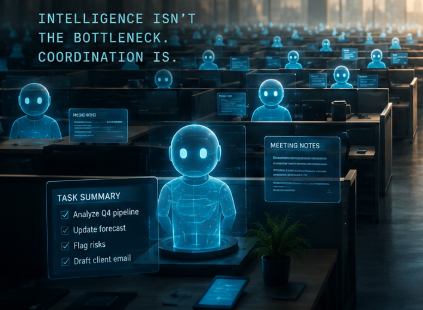
And the uncomfortable thing many organizations are discovering is that the hard part was never intelligence.
It was coordination.
After spending the better part of two decades working across internet infrastructure, machine learning, computer vision, and now generative AI adoption with companies across different industries, one pattern inside organizations has remained strangely consistent.
Different countries. Different sectors. Different leadership teams.
The complaints barely change.
Too many meetings.
Too many tools.
Too many updates.
Too many priorities competing for attention.
Everyone busy all day, but oddly unclear on what matters most.
The strange thing is that organizations have never had more visibility into themselves.
Meetings can be transcribed. Decisions documented. Customer interactions logged. Dashboards update in real time. Slack stores conversations indefinitely. AI can summarize weeks of work in seconds.
By most traditional measures, companies should be getting dramatically better at execution.
Yet many seem strangely stuck.
Projects stall without anyone fully understanding why. Teams drift into parallel interpretations of the same priority. Decisions made on Tuesday somehow require reinterpretation by Friday. Work moves, but not always in the same direction.
Executives often describe this as an information problem.
If only teams had better context.
If only systems were connected.
If only the data were cleaner.
If only AI could move work faster.
But working closely with organizations experimenting with AI adoption, another pattern starts becoming impossible to ignore.
Most companies do not lack intelligence.
Sales teams understand where deals are slipping.
Support often sees customer pain long before leadership does.
Engineering usually knows where technical debt is accumulating.
Legal identifies risk early.
Operations teams can often predict failure points weeks before they materialize.
Knowledge is rarely the scarce resource anymore.
Coordination is.
This is where much of the current conversation around enterprise AI starts to feel oddly disconnected from reality.
There is an assumption quietly embedded in the market that more intelligence naturally leads to better execution. Give organizations stronger models, richer context, autonomous agents, and performance will improve almost automatically.
Reality turns out to be messier than the demos.
In fragmented organizations, more intelligence often accelerates fragmentation.
McKinsey’s research on operating models points toward a stubborn truth: companies routinely fail to realize a significant portion of strategic value, not because strategy itself is weak, but because organizations struggle to translate intent into coordinated execution.* Most companies do not lose momentum at the level of ambition. They lose it somewhere between decision and follow-through.
Once you start paying attention, fragmentation becomes difficult to unsee.
A customer issue surfaces in support.
Sales hears complaints in calls.
Product debates prioritization.
Engineering follows a roadmap.
Legal introduces constraints.
Compliance raises flags.
Leadership makes decisions using incomplete visibility.
Everyone is acting rationally inside their own function.
The organization somehow becomes irrational as a whole.
Nobody planned it this way.
Scale simply has a habit of fragmenting reality.
Research into organizational siloing suggests this may be less a cultural flaw than a structural side effect of hierarchy itself.* Teams naturally optimize for local goals. Information clusters. Priorities diverge. Different departments slowly begin operating against slightly different versions of reality.
Most organizations try solving this problem the same way.
Add another tool.
Another dashboard.
Another planning layer.
Another workflow system.
Slack for communication.
CRM for customer visibility.
Linear or Jira for execution.
BI for analytics.
Notion for institutional memory.
The logic makes sense.
The results often disappoint.
Because fragmentation is not fundamentally a tooling problem.
It is an alignment problem.
Harvard Business Review has repeatedly argued that organizational silos persist precisely because companies reinforce them through reporting structures, incentives, and operational habits.* Most organizations know fragmentation hurts execution. They simply struggle to stop reproducing it.
This is where the current fascination with agents becomes genuinely interesting.
For the last two years, the AI market has been obsessed with autonomous systems. Agents that can research, coordinate workflows, summarize meetings, trigger actions, and increasingly operate with some degree of independence.
The demos are seductive.
A meeting ends and tasks appear instantly.
A customer complaint triggers workflows automatically.
Research assembles itself.
Decisions become structured memory.
Work starts feeling less manual.
What companies like Prosus and McKinsey are beginning to surface publicly, however, is something many working closely with enterprise AI have quietly observed for some time.
The difficult conversations begin only after the technology works.
Because once agents become operational, companies run into a different problem.
Trust.
Can an agent trigger communication with a customer?
Can it distinguish between brainstorming and an approved decision?
Does it understand regulatory boundaries?
Stakeholder dependencies?
Ownership?
Context?
Organizational politics?
Those questions sound operational until something breaks.
Then they become existential.
This is why the idea that agents alone will transform companies feels incomplete.
Without governance, automation scales confusion.
Without trusted context, intelligence creates noise.
Without clarity around ownership, faster systems create faster collisions.
McKinsey’s latest research on enterprise AI points to the same tension. Nearly every major company is investing in AI, yet only a small fraction believe they have reached meaningful maturity in operationalizing it.* Access to intelligence is no longer the constraint.
Organizing around intelligence is.
Deloitte reaches a similar conclusion from a different angle. Companies successfully scaling AI tend to treat governance not as bureaucracy, but as infrastructure. Permissions. Accountability. Transparency. Clear decision boundaries.* In practice, intelligence becomes useful only when organizations trust how it moves.
This is the part many AI narratives still miss.
The real shift may not be that companies are adding agents.
It may be that agents are exposing how fragmented organizations already were.
For decades, inefficiency was treated as the unavoidable tax of scale.
More meetings.
More management layers.
More process.
More software.
More reporting.
AI may be forcing a harder conversation.
What if many organizations were never especially good at coordinating human work in the first place?
Agents are simply making the weakness impossible to ignore.
The companies that move fastest over the next decade may not be the ones with the smartest models or the loudest automation strategy.
They may simply be the ones coherent enough to know what to do with intelligence once it arrives.
Because the deeper story of the AI era may not be artificial intelligence at all.
It may be whether organizations can finally learn how to stop working against themselves.
About Jose Larrucea
Jose Larrucea is founder and Chief AI Officer at MAXMEAI, a company building digital clones and AI systems for the next generation of human-machine interaction. He has worked in internet and artificial intelligence since the early 2000s, with experience spanning machine learning, computer vision, and generative AI adoption, including roles at Wix.com and RealNetworks. He is the author of BYOAI for Employees and AI Minds, and writes about AI, execution, digital identity, and the future of organizations.
Sources
* McKinsey & Company, A New Operating Model for a New World
https://www.mckinsey.com/capabilities/people-and-organizational-performance/our-insights/a-new-operating-model-for-a-new-world
* McKinsey & Company, Superagency in the Workplace: Empowering People to Unlock AI’s Full Potential at Work
https://www.mckinsey.com/capabilities/tech-and-ai/our-insights/superagency-in-the-workplace-empowering-people-to-unlock-ais-full-potential-at-work
* Harvard Business Review, What Cross-Silo Leadership Looks Like
https://hbr.org/2019/05/cross-silo-leadership
* Deloitte, Trustworthy AI
https://www.deloitte.com/nl/en/issues/generative-ai/trustworthy-ai.html
* Hierarchical Team Structure and Organizational Siloing
https://arxiv.org/abs/2203.00745
* Prosus, Building an Agentic Workforce: What We Have Learned From 30,000 AI Agents
https://www.prosus.com/news-insights/2025/building-an-agentic-workforce-what-we-have-learned-from-30000-ai-agents
* Business Insider, McKinsey Is Deploying Thousands of AI Agents
https://www.businessinsider.com/mckinsey-workforce-ai-agents-consulting-industry-bob-sternfels-2026-1
 Telepatico
You must be logged in to post a comment.