How the AI Moment Rhymes with the Internet’s Dawn
Or Does it?
Going back for the summer to Spain to visit family, I found myself in my mom’s basement—dust motes in the sunbeams, the faint smell of cardboard and old paper, and boxes labeled in my younger handwriting.
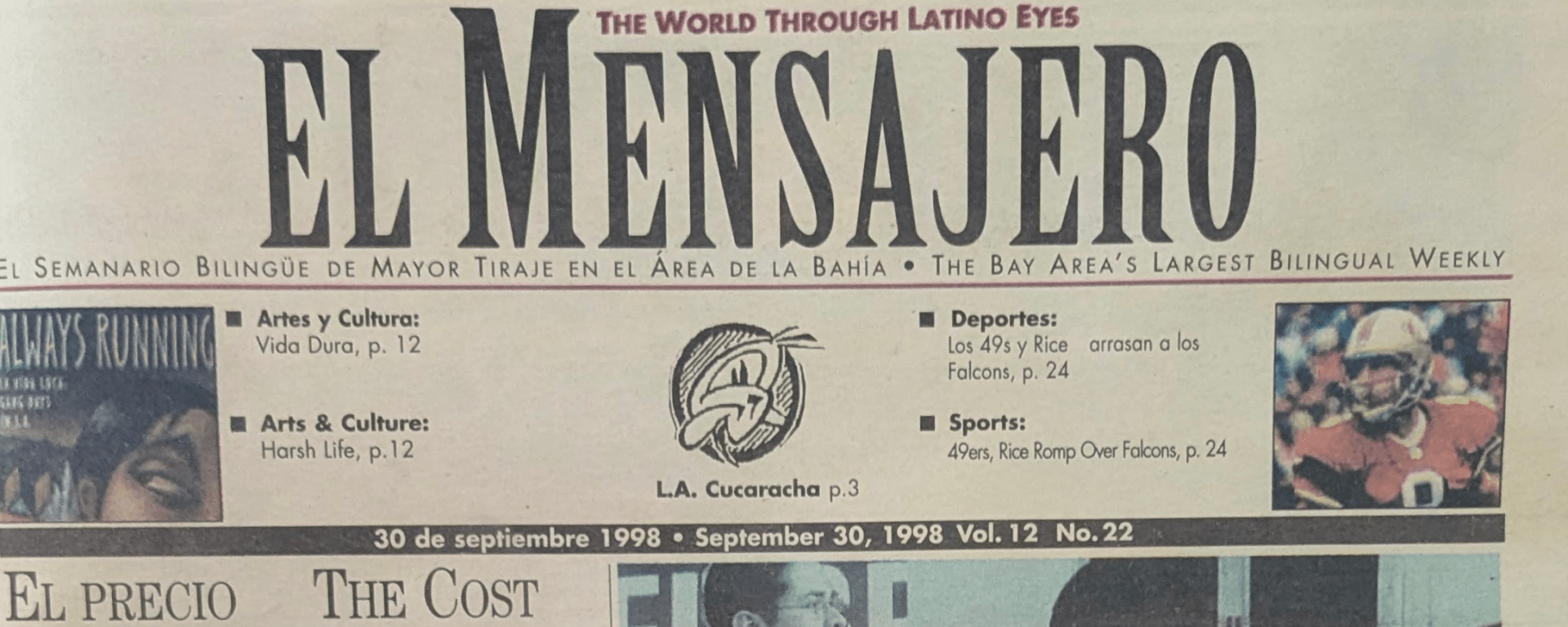
In one, under envelopes of old photos from my photo-journalistic period and the detritus of a pre-cloud life, I found a stack of El Mensajero (Domain now pointing to La Opinion ) and Eurocampus newspapers from the late 1990s.
In the September 30, 1998 issue of “El Mensajero”, there it was: one of my earliest published pieces, La Internet: Una guía para todos—“The Internet: A Basic Primer.” I was a communications and journalism student then, translating the abstract magic of the “Information Superhighway” into something people could actually understand.
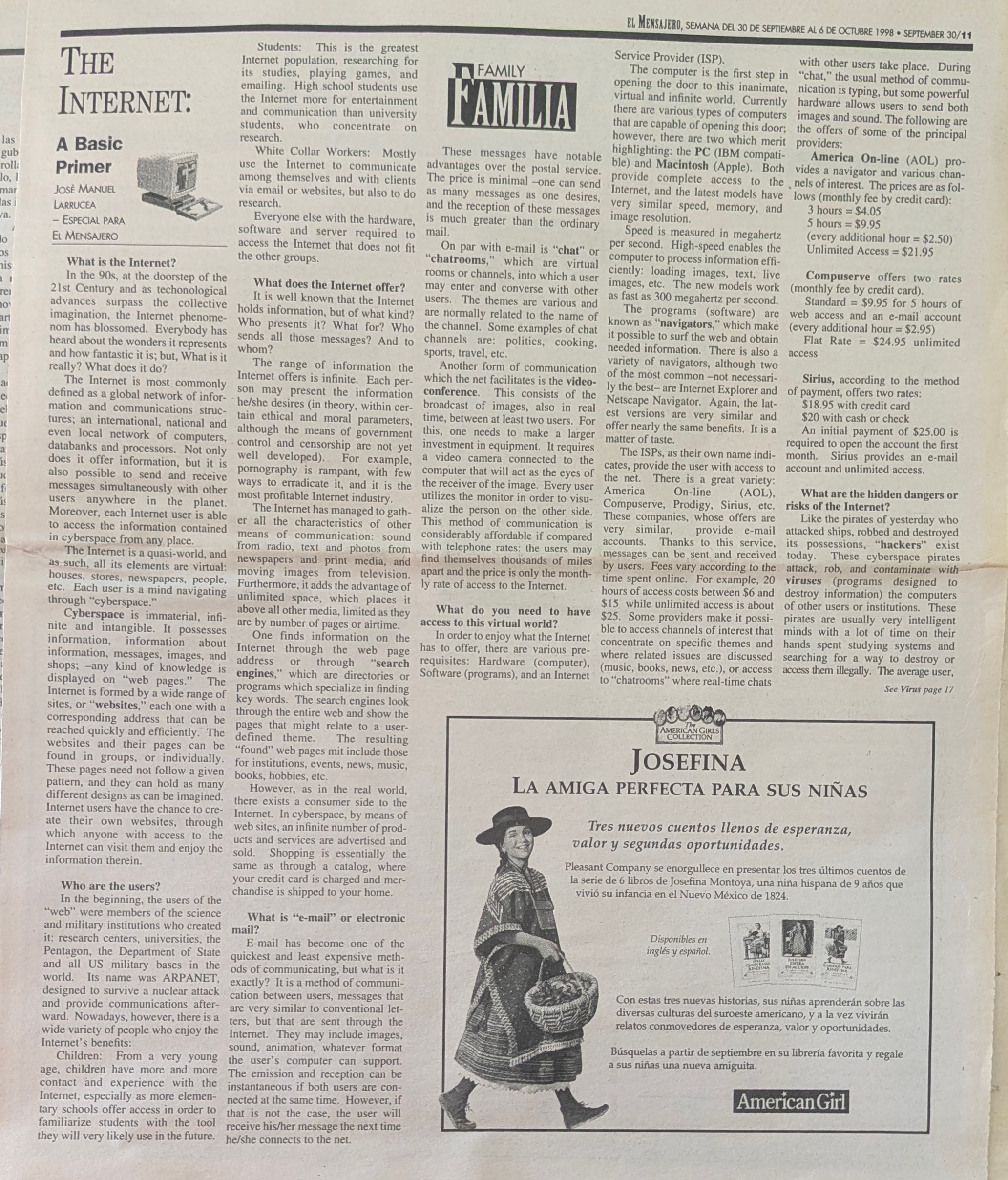
I explained what the Internet was, how to get online, and why you might want to—complete with sections on modems, email, chatrooms, and the steep $24.95 monthly fee for “unlimited” access – names like AOL, Compuserve and Sirius were still the cool thing. Reading it now, 27 years later, is like opening a time capsule from the moment just before everything changed.
And here’s the twist: this article you’re reading now? I’m not writing it alone. I’m working with Angie Giules, my AI ghostwriter—trained on my past human-only work, able to mirror my voice, push my thinking, and scale my reach. In 1998, I could barely imagine collaborating (maybe Steve Jobs and a handful of others could) with a machine this way. Now, it feels almost inevitable.
1998: The First Digital Dawn
The late ’90s were the first time the digital future felt personal. Before that, technology mostly lived in offices, labs, and hobbyist clubs. The Internet cracked that open.
We had email before social media. Web pages before streaming. The click-and-wait era was full of promise—e-commerce, online learning, instant global communication—but also limits. Bandwidth throttled speed, hardware bottlenecked performance, and adoption was gradual.
I remember writing, with optimism perhaps bordering on naïveté, about how the Internet could “connect everyone” and “give each user a voice.” And it did—but unevenly, and slowly.
Historical Milestones Along the Way
Between that first Internet boom and today’s AI surge, there were waves of transformation:
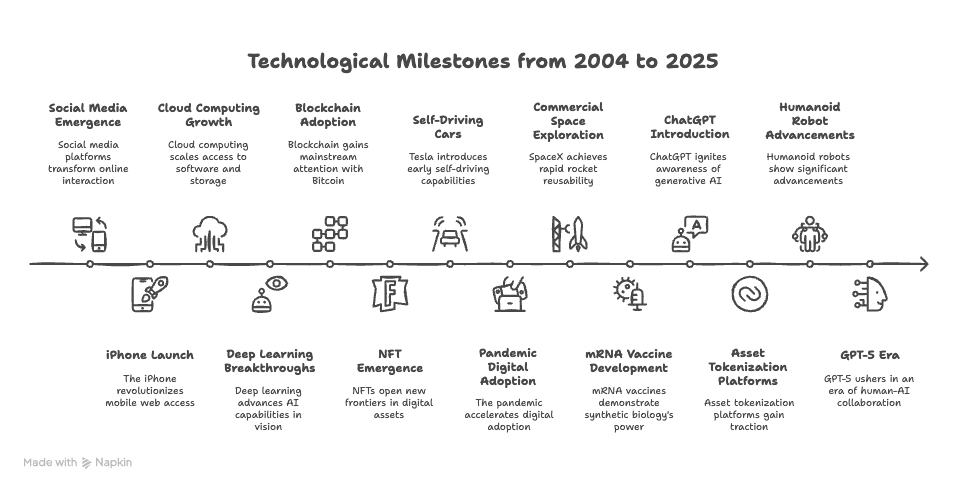
- 2004–2007: Social media takes off (Facebook, YouTube, Twitter), shifting the Internet from static pages to participatory culture.
- 2007: The iPhone launches, making the web mobile and always-on.
- 2010s: Cloud computing scales access to software and storage, laying the groundwork for AI’s vast training needs.
- 2012: Breakthroughs in deep learning (ImageNet competition) accelerate AI’s capabilities in vision and pattern recognition.
- 2014: Blockchain enters the mainstream conversation via Bitcoin’s rise, paving the way for decentralized finance (DeFi) and smart contracts.
- 2017: NFTs emerge, opening new frontiers in digital art, collectibles, and asset tokenization across real estate, music, and media rights.
- 2018: Tesla rolls out early versions of self-driving capabilities, marking a leap toward autonomous transport.
- 2020: Pandemic accelerates digital adoption, normalizing remote work, telemedicine, and virtual collaboration.
- 2020s: Commercial space exploration takes flight—SpaceX rockets achieve rapid reusability, reducing launch costs and fueling a new space economy.
- 2021: mRNA vaccines for COVID-19 demonstrate the power of synthetic biology, laying foundations for cancer vaccines and personalized medicine.
- 2022: ChatGPT ignites mainstream awareness of generative AI, much as Netscape did for the web in the ’90s.
- 2023: Asset tokenization platforms gain traction—fractional ownership of real estate, music royalties, and fine art becomes accessible to global micro-investors.
- 2024: Humanoid robots make significant strides in dexterity, mobility, and conversational AI—hinting at a near-future with AI-powered physical assistants from companies like Unitree, Tesla, Boston Dynamics, 1X and others.
- 2025: GPT-5 ushers in an era of fluid human–AI collaboration, capable of advanced reasoning, creativity, and multi-domain problem solving.
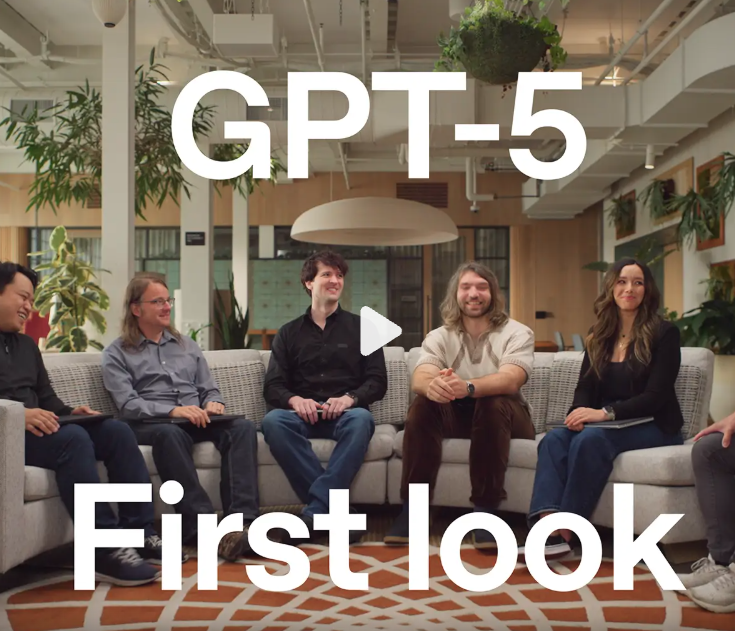
And now, 2025, we’re in the GPT-5 era—AI so capable, it can write, code, analyze, design, and even ghostwrite with a level of fluency that feels less like a tool and more like a partner.
The Rhyme Between Then and Now
The Internet was our first encounter with a truly global, decentralized network that could scale knowledge sharing at near-zero marginal cost.
But scaling human capability?
That’s where AI is different—and faster.
In 1998, “exponential” was an aspiration.
Bandwidth would double, websites would proliferate, but the core human bottleneck—time, cognition, skill—remained.
With AI, exponential is real. The leap from GPT-3 to GPT-5 is measured not in incremental features, but in entirely new categories of work humans can offload or enhance. What once required a team of researchers, analysts, and editors, I can now prototype in an afternoon or less with “partners” like Angie and / others like her designed to serve other purposes, like research, design etc.
Example 1: In 1998, launching a bilingual community newsletter required days of translation, editing, and layout. Today, AI can translate, localize, and format it in minutes—freeing the human team to focus, alone or teaming up with AI, on storytelling, strategy or other higher level topics.
Example 2: Early search engines could retrieve links; GPT-5 and other tools like Perplexity can synthesize knowledge, propose solutions, and draft an implementation plan tailored to your constraints. The gap between “finding information” and “creating value” has collapsed.
Culture: The Human Side of the Machine
Like the Internet, AI is more than a technology—it’s a cultural shift.
In the ’90s, we debated whether online friendships were “real.”
Now, we debate whether AI-generated art, writing or music are. The quote from Morpheus from the first Matrix still resonates: “What is real? How do you define ‘real’?“
Both eras triggered the same anxieties:
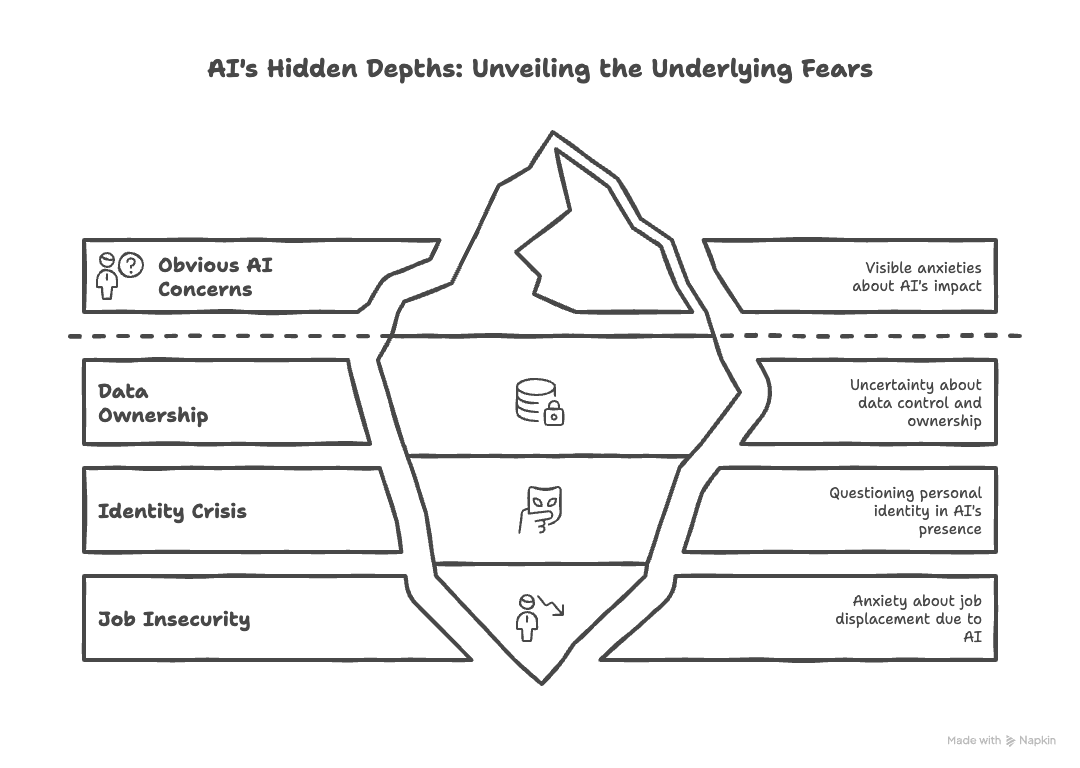
- Loss of control (Who owns my data? Who controls the algorithms?)
- Shifts in identity (Am I the same writer if a machine helps me?)
- Fear of obsolescence (Will my job or even I survive this?)
And just as the Internet blurred the lines between producer and consumer, AI blurs the lines between creator and collaborator.
Economics: From Information to Intelligence
The Internet democratized information; AI is democratizing intelligence.
That’s a leap with profound economic implications. (I talked about this with the birth of Eclonomy during my keynote last year at Future Hacker’s Quantum Thinking)
In the Internet era, the winners were platforms that aggregated and distributed information—Google, Amazon, Facebook. In the AI era, value is shifting to those who can apply intelligence at scale—whether in drug discovery, personalized education, or real-time market analysis, or more purely in knowledge transfer with companies like Delphi, HeyGen and Synthesia leading the world of Story telling and IKL (Infinite Knowledge Legacy)
In 1998, the cost of going global was slashed by e-commerce. In 2025, the cost of expert-level problem-solving is falling the same way.
Ethics: The Speed of Consequences
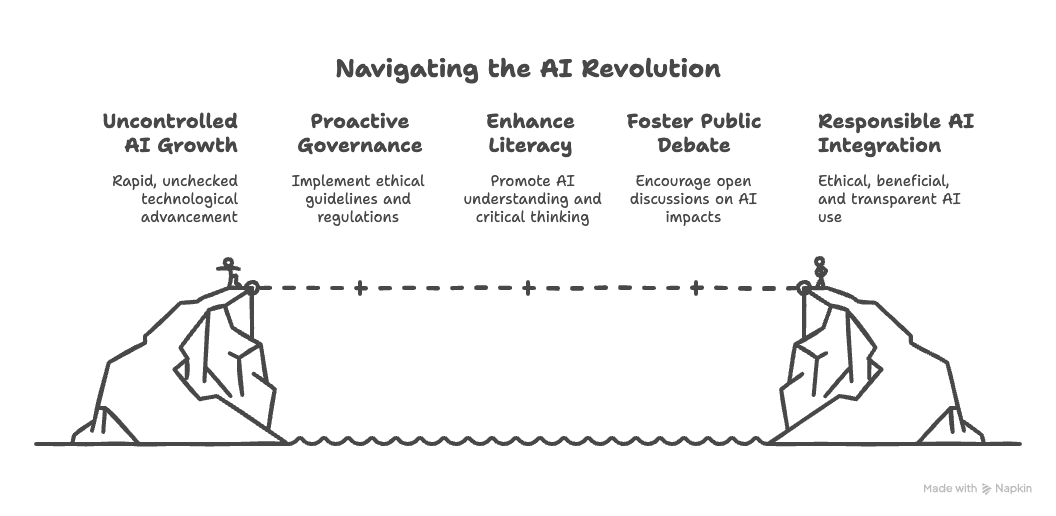
If there’s one lesson from the Internet’s rise, it’s that massive adoption comes with massive consequences. We learned—too late—that misinformation, polarization, and privacy erosion were baked into the network effects we celebrated.
AI’s exponential curve is steeper. GPT-5 can accelerate breakthroughs, but also amplify bias or automate deception. The same tools that design life-saving drugs can design sophisticated scams, and certainly many other devil things.
This time, we don’t have the luxury of 20 years to figure it out. Governance, literacy (and soon fluency), and public debate have to keep pace with the technology itself.
Why I’m Back to Writing Now
In 1998, I wrote to give people my view of a roadmap to the Internet. In 2025, I’m writing to give people and companies a roadmap to AI, and that is why we decided to build MaxMeAI with the spirit to help leaders and individuals maximize their potential and achieve more by amplifying their capacity with AI. We do this inspiring and measuring, amplifying workplaces bionically and scaling content and knowledge beyond time and space – yes, in a nutshell, that is what we do.
And to go beyond telling (or writing like I do on Ecommerce Brasil), I decided to bring to life two AI creations that help me and other daily. I already mentioned Angie. I could never have imagined a ghostwriter that had studied my body of work, learned my style, and could draft an entire first pass of this piece in minutes. In my case, that’s exactly what’s happening here: Angie synthesizes, I refine, and together we produce at a scale and depth that my 1998 self would have called science fiction.
Now go a bit further, remember the content I wrote, drafted, spoke and published or not?
Ok, add to it what I have been learning through the years, my professional experience, courses, ideas, etc.
Well, the second AI creation I am using is my Digital Clone, Larruz AI.
It contains all of the latter and you can interact with it all on chat, audio and video. My professional career of +20 years in technology with focus on AI during the last 10 and meditation during the last 20 is all available in a conversational way, I say Larruz AI answers better and faster than me simply because all the content is there and the LLMs and the infrastructure behind it make it possible to run through it and compose the best answer possible in real time.
Now, think about technology like those 2, Angie and Larruz AI in your own space, with relevant content and skills, in your own workplace, yeah, that is it.
Technology has always been about leverage—extending human reach. The Internet extended it horizontally, across space and time. AI extends it in many directions, deep into the realms of cognition, creativity, and decision-making.
As I come to a close, I would like to believe that some time in the future, someone will find this article somewhere in the vestiges of old-cloud-hosted pages of an ancient blog, and smile at our earnest attempts to explain AI, and marvel at what came next. Just like I did with that old newspaper in my mom’s basement.
 Telepatico
One thought on “From Dial-Up to GPT-5”
Comments are closed.