
A student submits a perfect assignment.
The structure is clean. The argument is coherent. The language is precise. There are no obvious gaps, no weak transitions, no signs of confusion. It is, by most academic standards, an excellent piece of work.
The problem is that no one can tell whether the student actually learned anything.
This is not a minor issue. It is a structural one.
For decades, the education system has relied on a simple proxy: if a student can produce the correct output—an essay, a solution, a project—then learning must have taken place. The artifact becomes the evidence. The submission becomes the signal.
That assumption worked when producing the output required internal effort. When writing meant thinking. When solving meant reasoning. When the path from question to answer passed almost entirely through the student’s own mind.
That path no longer exists in the same way.
Today, a student can delegate significant portions of that process to external systems. Not because they are avoiding learning, but because the environment allows—and even encourages—this delegation. The system generates structure, suggests ideas, refines expression, and in some cases completes the task end to end.
The student submits. The system grades. And somewhere in between, the connection between output and learning breaks.
“Completion is no longer evidence of understanding.”
This is the fracture.
It is not that students are cheating more. It is that the mechanism we use to detect learning has become unreliable. The artifact no longer proves the process. The result no longer guarantees the reasoning that produced it.
And yet, the system continues to operate as if nothing has changed.
Assignments are given. Submissions are collected. Grades are assigned.
But the underlying assumption—that producing the work implies internalization—has quietly collapsed.
This is where the conversation about AI in education often stops too early. It focuses on detection, on plagiarism, on whether the student or the machine produced the answer. But that is the wrong layer of the problem.
The real issue is deeper:
If intelligence is no longer confined to the student,
why are we still evaluating as if it were?
Education, at its core, was never about producing artifacts. It was about shaping intelligence—training attention, building judgment, developing the ability to engage with complexity. The essay, the exam, the task—these were proxies, not the objective.
Now the proxies are failing.
Because intelligence itself is changing its form.
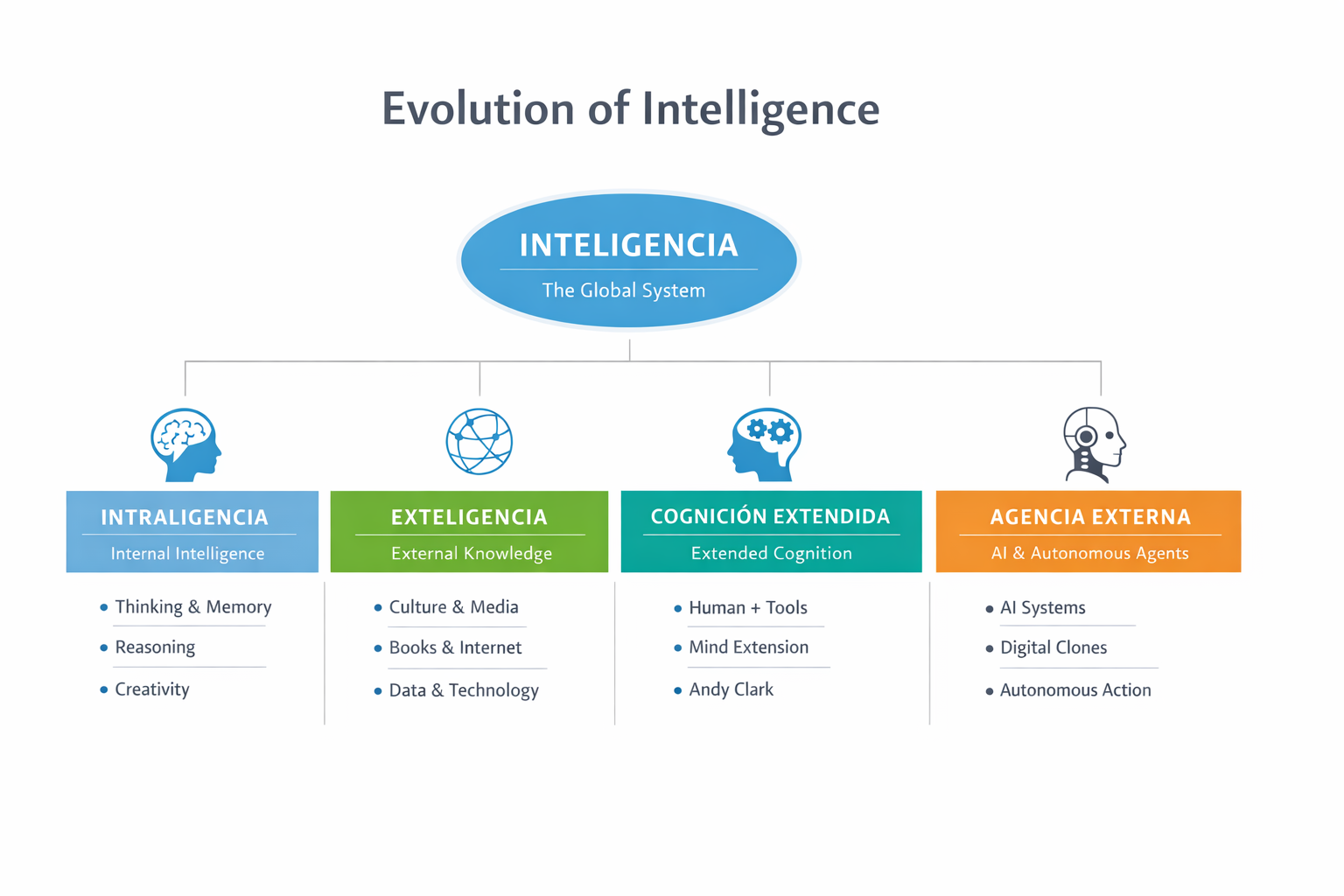
A student no longer operates solely through intraligence—the internal processes of memory, reasoning, intuition, creativity. They operate across a broader system that includes extelligence: knowledge embedded in external systems, now dynamic, responsive, and increasingly participatory.
The student does not simply recall or construct. They orchestrate.
This does not mean they are learning less. It means learning is happening in a different topology—one that the current system does not measure.
“Students are not outsourcing intelligence.
They are redistributing it.”
This redistribution introduces a fundamental tension. If part of the cognitive process happens outside the student, then the traditional model of assessment—based on isolated performance—becomes misaligned with reality.
We are asking students to demonstrate intelligence in conditions that no longer exist.
And then we are surprised when the signal becomes noisy.
The immediate reaction is often defensive: restrict tools, enforce constraints, bring students back into controlled environments where outputs can be trusted again. But this is a temporary fix. It attempts to preserve the validity of the old proxy rather than questioning whether the proxy itself still makes sense.
The more interesting question is not how to prevent students from using external systems.
It is how to design education in a world where they inevitably will.
“What if the goal is not to eliminate external intelligence, but to learn how to work with it without losing understanding?”
This shifts the problem entirely.
The challenge is no longer to ensure that students produce work independently. It is to ensure that they develop intelligence within a system where independence is no longer the default condition.
That requires a different foundation.
Instead of asking, “Can the student produce this output alone?” we need to ask:
- Does the student understand how the output was constructed?
- Can they explain the reasoning behind it, even if part of it was generated externally?
- Can they identify where the system is right, where it is wrong, and why?
- Can they decide what to delegate and what to retain?
In other words, the focus shifts from production to comprehension, from execution to judgment.
This is not easier. It is more demanding.
Because it removes the illusion that correct output equals understanding.
It forces us to look directly at the quality of the student’s thinking, even when that thinking is distributed across internal and external components.
The timing of this shift is not theoretical. It is already overdue. Students are already operating in this hybrid mode. The gap is not in behavior—it is in the system that evaluates it.
Where this change happens is equally important. It cannot be limited to isolated classrooms or experimental programs. It must permeate the entire structure of education, from early learning to higher education, because the underlying condition—the availability of external intelligence—is universal.
The question of who drives this change is more complex.
Institutions tend to move slowly, especially when their legitimacy depends on stable evaluation mechanisms. Teachers are often closer to the reality of what is happening, but constrained by curriculum and assessment frameworks. Students adapt fastest, but have the least formal authority to redefine the system.
In practice, change will likely emerge from a combination of pressure and experimentation—educators testing new forms of assessment, institutions recognizing the limitations of existing models, and external forces making the old system increasingly untenable.
But the direction is clear.
If intelligence is no longer local, then education cannot remain local either.
It must evolve into something that operates across layers:
- the internal development of reasoning and judgment
- the external navigation of systems and knowledge
- the integration of both into coherent action
This is not about abandoning the human core. It is about redefining its role.
The value of the student is no longer in producing answers that can be generated elsewhere. It is in maintaining coherence across a system where answers can come from multiple places.
That includes:
- knowing what to ask
- knowing what to trust
- knowing what to challenge
- knowing what to take ownership of
These are not secondary skills. They are the new center.
“Learning is no longer proving that you can do it alone. It is proving that you understand w
hat happens when you don’t.”
This reframing is uncomfortable because it removes a clear boundary. It blurs the line between the student and the system, between internal effort and external contribution. But that boundary was never as stable as we assumed. It was simply easier to manage.
Now, it is dissolving.
The student who submits the perfect assignment is not necessarily failing the system.
The system may be failing to ask the right question.
Not “Did you produce this?”
But:
“Where did your intelligence operate
in this process, and do you understand it?”
That question is harder to grade. It resists standardization. It requires conversation, interpretation, and a deeper engagement with how thinking actually happens.
But it aligns with reality.
And that is where education needs to go.
Not toward tighter control of outputs, but toward a clearer understanding of how intelligence now moves—across bodies, across systems, across boundaries—and how to develop it without losing its core.
Because the future of education is not about protecting learning from external intelligence.
It is about ensuring that, as intelligence expands beyond the individual, understanding also stays and grows with with it.
{ “@context”: “https://schema.org”, “@type”: “FAQPage”, “mainEntity”: [ { “@type”: “Question”, “name”: “What does it mean that intelligence is no longer local?”, “acceptedAnswer”: { “@type”: “Answer”, “text”: “It means that intelligence is no longer confined to the human brain. It operates across both internal cognition (intraligence) and external systems (extelligence), forming a distributed system of thinking.” } }, { “@type”: “Question”, “name”: “What is extelligence?”, “acceptedAnswer”: { “@type”: “Answer”, “text”: “Extelligence is intelligence that exists outside the individual, embedded in culture, language, technology, and AI systems. Originally described by Ian Stewart and Jack Cohen, it now includes dynamic systems that actively participate in thinking.” } }, { “@type”: “Question”, “name”: “What is the difference between extended cognition and cognitive extensions?”, “acceptedAnswer”: { “@type”: “Answer”, “text”: “Extended cognition is a theory proposed by Andy Clark that explains how thinking can include external systems. Cognitive extensions are the actual tools and systems, such as AI and agents, that enable this distributed thinking.” } }, { “@type”: “Question”, “name”: “Why is AI disrupting education?”, “acceptedAnswer”: { “@type”: “Answer”, “text”: “AI breaks the traditional link between producing an output and proving learning. Students can generate high-quality work using external systems, making it harder to assess whether real understanding has taken place.” } }, { “@type”: “Question”, “name”: “What skills should students learn in the age of AI?”, “acceptedAnswer”: { “@type”: “Answer”, “text”: “Students need to learn how to frame problems, evaluate outputs, orchestrate multiple intelligence systems, and decide what to delegate versus what to retain. Learning shifts from memorization to designing and managing intelligence systems.” } }, { “@type”: “Question”, “name”: “What is the future of education with distributed intelligence?”, “acceptedAnswer”: { “@type”: “Answer”, “text”: “Education will need to evolve from testing isolated performance to developing the ability to operate across layers of intelligence. The focus will shift toward judgment, system design, and maintaining coherence in a distributed cognitive environment.” } } ] } Telepatico
You must be logged in to post a comment.